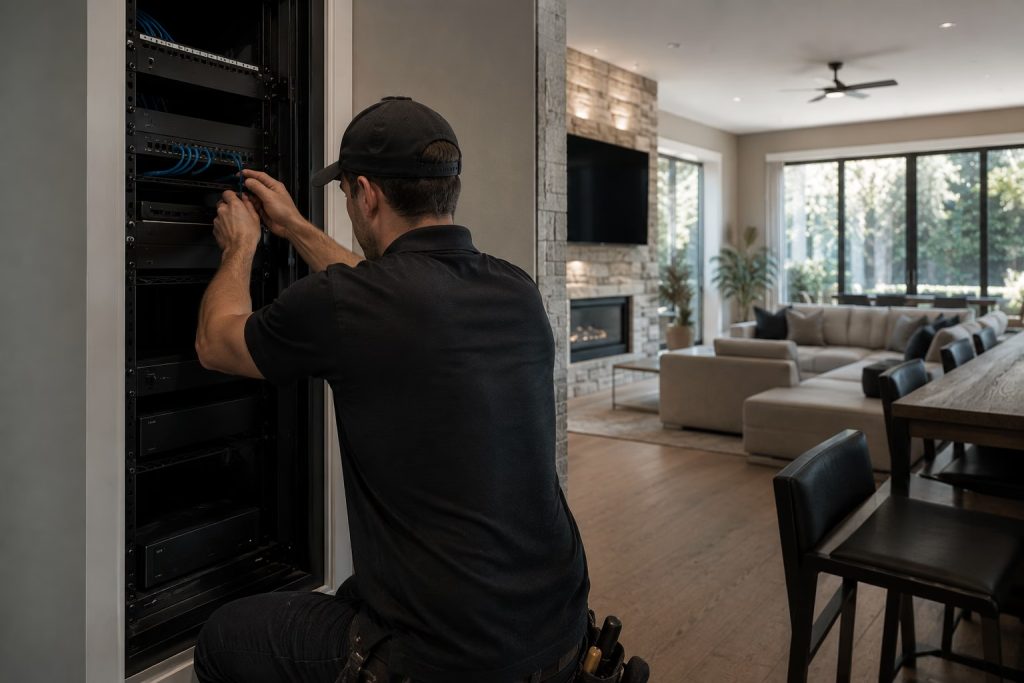
At some point in every smart home project, you hit the wall where DIY stops being fun. Maybe it’s whole-house lighting. Maybe it’s motorized shades on second-story windows, or speakers in ceilings you’d rather not open twice. That’s when you start googling installers, and that’s when you discover this industry has a price range that runs from “weekend handyman” to “small yacht.”
I’ve watched neighbors go through this, and the difference between a great outcome and an expensive regret usually comes down to questions asked before any contract got signed. Here’s the short list that matters.
The Questions That Separate Pros From Salesmen
Are they certified, licensed, and insured? CEDIA certification is the industry’s gold standard for home technology integrators, and a licensed electrician on staff is the floor, not a bonus. Anyone offended by the question has answered it.
What do they actually install? Some shops are single-brand dealers who will solve every problem with the one system they sell. Others are genuinely multi-brand. Neither is wrong, but you want to know which conversation you’re in. Ask what they’d do with the gear you already own, and whether their systems play with Matter and the mainstream platforms or lock you into a proprietary app.
What happens when it breaks? The install is the honeymoon. Ask about warranty length and whether it covers labor and software, not just hardware. Ask if they do remote diagnostics or roll a truck for every hiccup, and what the truck costs. A good integrator talks about the support relationship unprompted, because that’s where their business lives.
Can it grow? Systems built on standard protocols and modular designs can expand room by room. Systems built as a sealed monolith can too, for a price that will make you sit down. Get the upgrade story in writing.
Will the system survive an internet outage? Local control, battery backup, cellular failover for security components. The premium systems handle this well; the budget ones vary wildly. Worth five minutes of the sales meeting.
And the universal rule: get references from jobs at your budget level, not their portfolio showpiece, and actually call them. Past customers will tell you about the change orders, the missed timelines, and whether anyone answers the phone in month eight.
Top Home Automation Installation Providers Compared (2026)
The home automation installation market ranges from national brands with certified dealer networks to independent local integrators. Here’s how the major players compare:
| Provider | Best For | Typical Cost | Ecosystem | Pros |
|---|---|---|---|---|
| Control4 (Snap One) | Whole-home luxury | $5K-$50K+ | Proprietary + integrations | One unified system, professional support |
| Savant | Apple-centric homes | $10K-$100K+ | Proprietary, Apple-friendly | Premium interface, excellent AV |
| Crestron | Commercial/high-end | $15K-$200K+ | Proprietary | Most powerful, enterprise-grade |
| Local Integrator (CEDIA-certified) | Custom solutions | $2K-$30K | Varies (often multi-brand) | Flexible, personalized service |
| DIY + Professional Tune-Up | Budget-conscious | $500-$3K | Matter/HomeKit/Google/Alexa | Lowest cost, most flexible |
Our recommendation: For most homeowners, a CEDIA-certified local integrator offers the best balance of expertise, customization, and cost. They can mix and match products from different brands to build exactly what you need. If you’re considering Control4 specifically, read our deep dive into the Control4 system first. For a broader overview of companies in the space, see our top home automation companies roundup.
What Does Home Automation Installation Actually Cost?
One of the biggest questions homeowners have is cost. Here’s a realistic breakdown by project scope:
- Basic smart home package (thermostat, locks, doorbell, a few lights): $500-$2,000 — often DIY-friendly, professional install adds $200-$500
- Mid-range whole-home system (lighting control, security, climate, speakers): $3,000-$15,000 — typically requires professional installation and programming
- Premium whole-home automation (Control4/Savant/Crestron with motorized shades, distributed AV, networking): $15,000-$100,000+ — always professionally installed
- New construction pre-wire + install: Add 15-25% to the above for structured wiring during construction (see our smart home wiring guide for new construction)
Frequently Asked Questions
Should I hire a professional installer or do it myself?
It depends on the complexity. Smart speakers, plugs, and basic lighting can easily be DIY — check our $500 starter guide for a solid DIY approach. However, for whole-home lighting control, distributed audio, motorized shades, or security systems, a professional installer ensures proper wiring, programming, and a seamless user experience. The cost of fixing a botched DIY wiring job often exceeds the cost of professional installation.
What certifications should I look for in an installer?
The gold standard is CEDIA certification (Custom Electronic Design and Installation Association). CEDIA-certified installers have demonstrated expertise in home technology integration. Also look for manufacturer certifications — Control4 has an authorized dealer program, and Lutron has a HomeWorks certified installer program. At minimum, any electrician doing smart home wiring should be licensed in your state.
How long does a typical home automation installation take?
A basic smart home setup (thermostat, locks, cameras) can be done in a single day. A mid-range whole-home system typically takes 2-5 days for installation and programming. A full luxury installation with pre-wiring, AV distribution, and automation programming can take 2-6 weeks, especially in new construction where the installer coordinates with electricians and builders.



