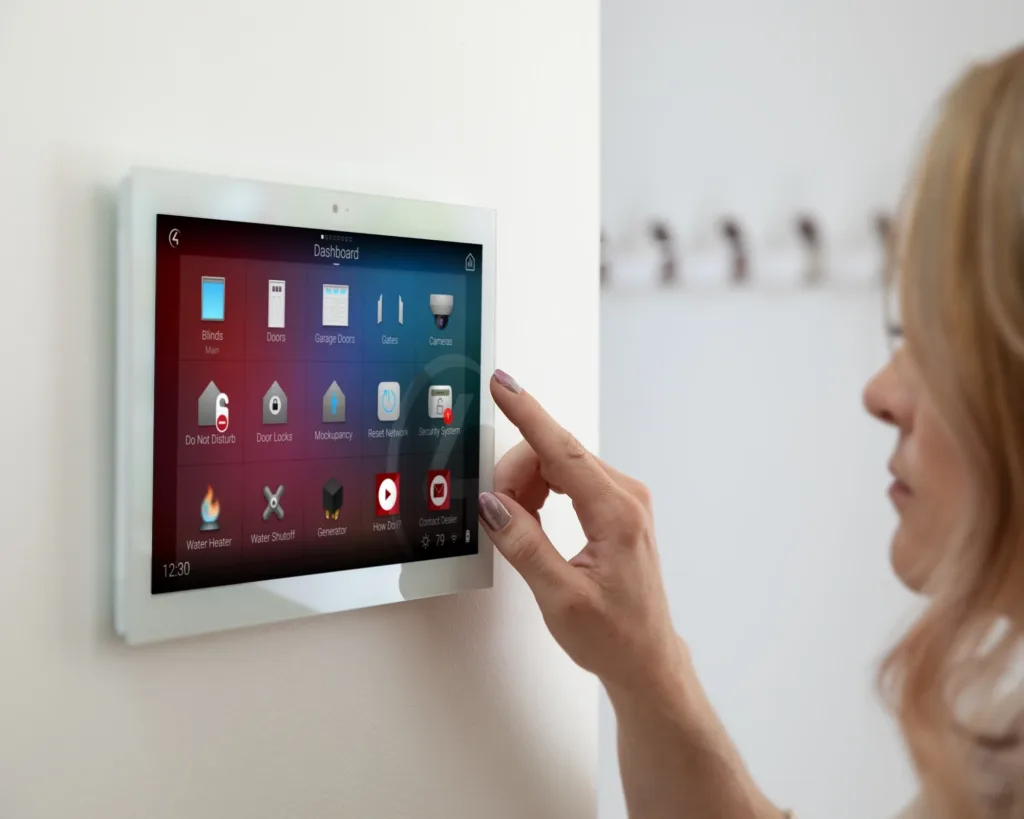
Most smart home gear you buy. Control4 you commission. That single distinction explains almost everything about it — the price, the polish, the fact that you can’t just add it to a cart, and the reason it still exists in a world where a $30 plug does half of what it does. It’s the difference between assembling your own setup and hiring someone to build you one that just works, then hands you a remote and walks away.
I don’t run Control4 at my house. I’m a Lutron Caséta-and-tinker guy — I’d rather wire it up myself and save the money. But I’ve spent enough time around Control4 installs to know exactly who it’s for and who’s about to overpay for it. Here’s the honest 2026 rundown: what it is, what it costs, and whether it’s the right call for you.
What Control4 Actually Is
Control4 is a professional, whole-home automation platform. One brain runs the entire house — lights, climate, security, cameras, locks, shades, multi-room audio and video, the AV rack behind your TV — and ties it together into scenes you trigger from a wall keypad, a touchscreen, a handheld remote, your phone, or your voice. Press “Goodnight” and the lights fade, the doors lock, the thermostat drops, and the TV shuts off. Press “Movie” and the shades close, the lights dim to ten percent, the projector drops, and the receiver switches to the right input. That’s the pitch: not individual gadgets, but one coordinated system that behaves like it was designed on purpose, because it was.
The catch is right there in “professional.” You don’t buy Control4 and set it up over a weekend. A certified dealer designs it, installs it, and programs it. You’re buying their work as much as the hardware.
Who Owns It Now — and Why You Should Care
Control4 has changed hands a couple of times, and the latest move matters if you’re signing up for a system you’ll live with for a decade. It was folded into Snap One (the old SnapAV) years back, and in June 2024 Resideo acquired Snap One for roughly $1.4 billion. So Control4 now sits under Resideo — the same company behind Honeywell Home thermostats and First Alert — distributed through its ADI Global network.
Why care? Because Control4 is a dealer-channel product, and the health of that channel is the whole game. A bigger, better-capitalized parent generally means the platform keeps getting updates and the dealer network stays supported. It’s a reasonable bet that the system you buy in 2026 will still be getting firmware in 2030. With a dealer-locked platform, that staying power is worth real money.
The Hardware, and Why You Can’t Just Buy One
The heart of a Control4 system is the controller. The current lineup is the CORE series — CORE 1, CORE 3, and CORE 5 — which replaced the older EA controllers. They run multi-core processors and the latest Control4 OS 3, and the bigger ones double as high-resolution multi-room music servers, streaming Spotify, Tidal, Qobuz, and the rest straight out of the box. CORE 1 handles a room or a small home; CORE 3 covers a mid-size whole-home project; CORE 5 is for the big, device-heavy installs.
Here’s the part people trip over: you can’t buy one and program it yourself. Control4 hardware is sold and configured exclusively through certified Control4 dealers. There’s no DIY path, no “buy the controller on Amazon and watch a YouTube tutorial.” If a unit shows up on a marketplace listing, it still needs a dealer’s credentials to actually do anything. That’s by design — it’s how the company guarantees the install quality — and it’s also the single biggest reason Control4 isn’t for everyone.
What It Works With
This is where Control4 earns its keep. It speaks to a genuinely enormous range of gear — thousands of certified devices — and it’s brand-agnostic in a way the consumer ecosystems aren’t. Lutron lighting and shades, Sonos and high-end AV receivers, Nest and ecobee thermostats, Ring and other cameras, Yale and Kwikset locks, garage doors, pool controls — it pulls all of it under one roof. For voice, it ties into Alexa and Google, and on the luxury end it pairs with Josh.ai, the natural-language assistant built specifically for high-end automation.
That breadth is the real argument for a system like this. If you’ve got a serious AV rack, motorized shades, and a security setup that all need to behave as one thing, Control4 is built to conduct exactly that. A pile of standalone apps can’t.
What It Costs
There’s no price tag, and that’s intentional. Control4 is quoted, not listed. A modest setup — a controller, a few keypads, some lighting and a little audio — can land in the low thousands. A true whole-home system with lighting, climate, multi-room AV, shades, and security routinely runs from the mid five figures into six, depending on the size of the house and how deep you go. The hardware is only part of it; you’re also paying for design, installation, programming, and the dealer relationship that comes after.
And that relationship is ongoing. Want to add a room, change a scene, or reprogram a keypad down the road? That’s usually a call to your dealer, sometimes a billable one. Some integrators offer remote tweaks and service plans. It’s worth asking exactly what minor changes cost before you sign, because “I just want the porch light on the Goodnight scene” shouldn’t turn into a service ticket.
Who Should Actually Buy It
Be honest with yourself here. Control4 makes sense if you’re building or seriously renovating, you’ve got a substantial AV and lighting footprint, and you genuinely want the whole thing handled — designed, installed, and supported — rather than spending your weekends in an app. For a big house where reliability and a single, polished interface matter more than the cost, it’s superb. People who buy it tend to love it, and the reliability is the whole point.
It does not make sense if you enjoy the tinkering, you’re outfitting a normal-sized home, or you’re price-sensitive. The honest truth in 2026 is that off-the-shelf gear has closed a lot of the gap. With Matter maturing and platforms like Home Assistant getting genuinely powerful, a determined DIYer can build something that does 80% of what Control4 does for a fraction of the price — you just trade dollars for your own time and patience.
The DIY Alternative, Briefly
If reading the pricing section made you wince, that’s your answer, and there’s no shame in it. Start with my guide to building a smart home from scratch, lean on Matter for cross-brand compatibility, and you can assemble a setup that handles lighting, climate, locks, and routines for a few hundred dollars. It won’t have a dealer on call or a single flawless interface, but it’ll do the daily jobs just fine — and you’ll actually understand how it works. If you want to compare the managed players head to head, my rundown of the top home automation systems puts Control4 next to its real rivals.
The Verdict
Control4 is the right tool for a specific job: a large, gear-heavy home where someone wants automation that’s designed, installed, and quietly maintained by a professional, and where the budget supports it. In that lane it’s excellent, and the fact that you commission it instead of building it is the feature, not the flaw. For everyone else — which is most of us — the DIY route gets you most of the way there for a tiny fraction of the cost. Know which person you are before the dealer comes out to quote, and you won’t be disappointed either way.



