Here is the conversation that kills most smart thermostat upgrades before they start. You pull the old thermostat off the wall, you see a little nest of wires, and somewhere on the internet a forum guy informs you that without a “C-wire” you are out of luck. Maybe an HVAC tech echoes it, right before quoting you a few hundred dollars to run a new one.
It is mostly nonsense in 2026. The C-wire (the “common” wire that delivers continuous power) is genuinely useful, but the entire industry figured out years ago that older homes do not have one. So the good thermostats either steal a trickle of power from the wires you already have, or they ship with a little adapter that solves it for free. I live in a house old enough to have opinions about its own wiring, and none of the four picks below needed me to open up the furnace.
Quick take before we go deep: For a standard furnace and AC, the Google Nest Thermostat is the easy yes at around $130. On a budget, the Wyze includes the adapter in the box for about $80. For a whole-home setup or an Apple Home household, the ecobee Enhanced earns its premium. Already all-in on Alexa and want cheap, the Amazon Smart Thermostat does the job.
First, Do You Even Have a C-Wire? A Two-Minute Check
Before you buy anything, pull your current thermostat off the wall (just the faceplate, the wires stay put) and look at the lettered terminals. You are hunting for a wire seated in the terminal labeled C. If there is one, great, every thermostat on earth will work and you can buy on features alone. If the C terminal is empty, you are in no-C-wire territory, which is exactly what this list is for.
Snap a photo of the wiring before you touch anything. You will want it during setup, and ecobee and Nest both have apps that read your photo and tell you what you are working with. If wiring photos make your palms sweat, that is normal, and it is also covered in our smart home from scratch guide.
How These Things Pull Off the No-C-Wire Trick
Two approaches, and it is worth knowing which one you are buying:
- Power stealing. The thermostat sips a small amount of current through the existing heating and cooling wires. Google Nest and several Honeywell and Sensi models do this. It is clean and wire-free, and it works in the large majority of homes. The catch: on a few sensitive or high-efficiency HVAC systems it can cause short cycling or a “low battery” sulk.
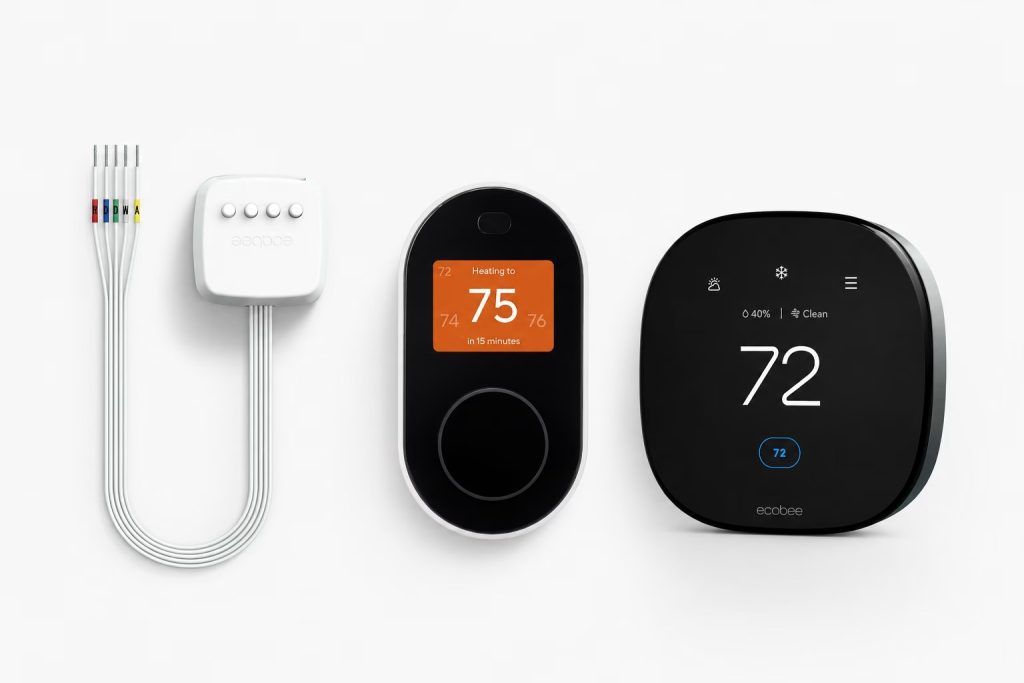
- Included adapter. The thermostat comes with a small module (ecobee calls theirs the Power Extender Kit) that you wire in at the furnace control board to create a proper common wire. A few more minutes of work, rock-solid result. ecobee, Amazon, and Wyze go this route.
Neither is wrong. Power stealing is simpler at the wall. An adapter is more bulletproof if your system is finicky.
The Four Picks
1. Google Nest Thermostat, Best for Most People

The Nest Thermostat (the newer, lighter model, not the pricey Learning version) is the one I steer most people toward. It uses power stealing, so in most homes there is no adapter and no furnace trip. Install runs about 30 minutes, the mirrored screen looks far more expensive than it is, and it quietly nudges your schedule toward less waste without the lectures. It plays nicely with Google Home and Alexa, and it is Energy Star certified, which matters more than it sounds when you watch the savings stack up.
The honest caveat: power stealing is the one approach that occasionally argues with an oddball HVAC setup. If you have a high-efficiency or dual-fuel system, read the Nest compatibility checker results carefully before you commit. For everyone with a standard furnace and AC, it is the easy yes.
Price: ~$130
No-C-wire method: Power stealing (no adapter in most homes)
Works with: Google Home, Alexa
Best for: Most standard furnace-and-AC homes that want the easy win
2. Wyze Smart Thermostat, Best on a Budget

Wyze keeps doing the thing where they charge a third of what everyone else does and the product is annoyingly good. The Smart Thermostat ships with a C-wire adapter in the box, so the no-C-wire problem is solved for you out of the gate, and it lands around $80 depending on the sale. The app is simple, scheduling is painless, and it does the 90 percent of smart-thermostat work that most people actually use.
You give up some polish and the deeper ecosystem hooks, and the build feels like the budget pick it is. But for a spare bedroom, a rental, or a first toe in the water, the value is hard to argue with.
Price: ~$80
No-C-wire method: Adapter included in box
Works with: Alexa, Google Assistant
Best for: Tight budgets, rentals, secondary rooms
3. ecobee Smart Thermostat Enhanced, Best for a Whole-Home Setup
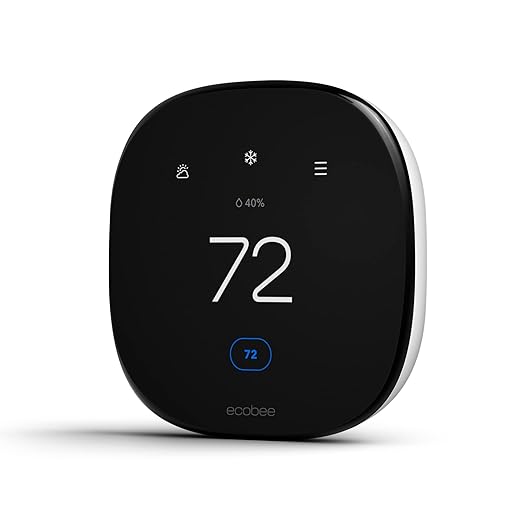
If you want one thermostat to run the whole house intelligently, ecobee is the grown-up choice. The Enhanced (and the step-up Premium) include the Power Extender Kit, so a missing C-wire is a non-issue, and ecobee’s room sensors let you prioritize comfort where people actually are instead of wherever the thermostat happens to hang. Alexa is built in, and it supports Apple Home, which makes it the pick if you live in the HomeKit world.
It costs more, generally north of $130 and up from there, and the Power Extender Kit install is a few extra minutes at the furnace. For a main living space, especially a multi-story home with hot and cold spots, it earns the premium.
Price: ~$130 and up
No-C-wire method: Power Extender Kit included
Works with: Alexa (built in), Apple Home, Google Home, SmartThings
Best for: Whole-home control, multi-story homes, Apple Home households
4. Amazon Smart Thermostat (with C-Wire Adapter), Best Cheap Brand Name

Built on Honeywell Home guts and tuned for the Alexa universe, the Amazon Smart Thermostat is the quiet value play. The thermostat on its own needs a C-wire, so for an older home you want this bundle: it ships with Amazon’s C-Wire Power Adapter, which wires in at the furnace and supplies the common wire your house does not have. Energy Star certified, dead simple, and a natural fit if your house already answers to Alexa.
The trade-off is ecosystem lock-in. There is no Apple Home support and no real Google Home story, so if you are not an Alexa household, one of the picks above will serve you better.
Price: ~$80 to $90 (bundle)
No-C-wire method: C-Wire Power Adapter included in this bundle
Works with: Alexa only
Best for: Alexa households that want the cheapest brand-name option
What to Actually Look For
Match the power method to your system. Standard furnace and AC, power stealing is fine and simpler. High-efficiency, dual-fuel, or anything that has given other thermostats trouble, go with an adapter-based pick and skip the guesswork.
Buy for the ecosystem you already run. A thermostat you talk to ten times a week should answer to the assistant your house already uses. Apple Home narrows the field to ecobee fast. Alexa-only homes have the most options.
Sensors matter more than spec-sheet numbers. The real comfort upgrade in a multi-room home is remote room sensors, which let the system heat and cool where people are. That is ecobee’s edge, and it is worth more than a slightly higher number on paper.
The Bottom Line
The missing wire was never the dealbreaker the internet made it out to be. A thermostat that stops heating and cooling an empty house pays for itself faster than almost anything else in the smart home, and we broke down where those savings actually come from in our guide to smart home energy monitoring. Want a real number for your own house before you spend a dime? Run it through our energy savings calculator. No email, no catch.
If you are building a home you plan to keep adding to, give the Matter question thirty seconds of thought so you are not boxing yourself in. Then pick the camp your house falls into, give it an afternoon, and let the thing start earning back its price the first month. Standard setup, most people: Nest. Tight budget or a rental: Wyze. Whole house or Apple Home: ecobee Enhanced. Cheap and all-in on Alexa: Amazon.



