Your smart plug shouldn’t just sit there being switched on and off. In 2026, the best ones in this category tell you how much power a device is actually drawing. That information is more useful than it sounds. You’ll find the appliance on your counter that pulls 180W on standby. You’ll identify the space heater quietly running up 40% of your electric bill. You’ll know whether your “energy efficient” appliances actually live up to their labels.
Energy monitoring smart plugs have been a niche product for years. They’re getting more mainstream as electricity costs keep climbing and as the Matter protocol finally makes cross-platform setups less painful. The three picks below are what actually delivers in 2026, tested extensively, recommended repeatedly in smart home communities, and honest about what they can and can’t do.
The Three Picks
1. Kasa KP125M, Best Overall for Most Smart Homes
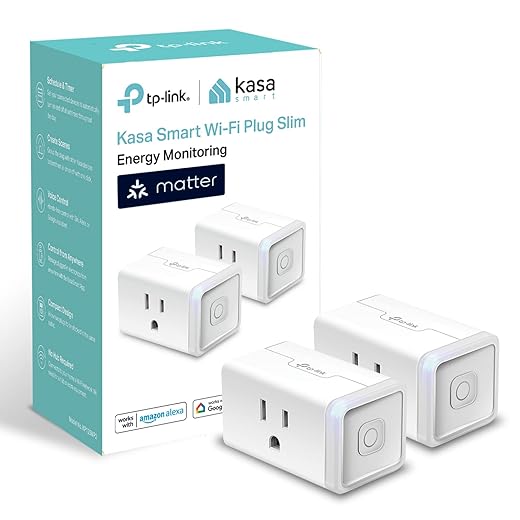
The KP125M is the one to buy if you want one plug that works everywhere. It’s Matter-certified, which means it works with Apple Home, Amazon Alexa, Google Home, and Samsung SmartThings out of the box. Setup is a QR code scan. The compact design doesn’t block the adjacent outlet. At roughly $20 per plug in the two-pack, it’s not asking you to make a major commitment.
The energy monitoring lives in the Kasa app. You get real-time wattage, monthly usage history, and cost estimates based on your entered rate per kWh. It’s not enterprise-grade data, but it’s actionable. Reviewers at BGR and Reviewed.com both called out the KP125M as the best all-around Matter plug tested, consistent, compatible, and reliable in long-term use.
One thing to know: some users report spotty HomeKit connectivity until they have a dedicated hub (HomePod mini or Apple TV 4K) acting as a home hub. With one, it’s solid. Without one, mileage may vary. If you’re running HomeKit without a hub in 2026, that’s a problem that extends well beyond smart plugs.
Price: ~$40 for a 2-pack (~$20/plug)
Works with: Apple Home, Alexa, Google Home, SmartThings (Matter)
Energy monitoring: Kasa app only
Best for: Mixed-ecosystem homes, most people starting out
2. Kasa EP25 (4-Pack), Best Budget Pick for HomeKit Users

If you’re deep in Apple HomeKit and you want plugs you can drop around the house without spending $25+ per unit, the EP25 is the play. It’s HomeKit-native (not Matter bridged), which means it connects directly to Apple Home without needing a Matter hub. At roughly $12-13 per plug in the four-pack, it’s the cheapest way to get reliable HomeKit coverage.
The trade-off versus the KP125M is that energy monitoring here is more limited, and the EP25 doesn’t carry the same multi-ecosystem flexibility. If you own Google speakers and Apple devices both, the KP125M is the better choice. But if your home is Apple-first and you want plugs everywhere, lamps, fans, holiday lights, coffee maker, the EP25 four-pack is how you do it without overthinking it.
Scheduling, timers, and automations all work natively in the Home app. The physical design is small and doesn’t hog the outlet. Works on 2.4GHz Wi-Fi, which matters in older homes with mixed networking setups.
Price: ~$50 for a 4-pack (~$12.50/plug)
Works with: Apple Home (native HomeKit), Alexa, Google Home
Best for: HomeKit households wanting broad coverage on a budget
3. Eve Energy (Matter), Best for Privacy-First HomeKit Users

Eve is the German company that has been doing HomeKit hardware longer than almost anyone, and the Eve Energy (Matter) is the version of their plug that’s finally ubiquitous across ecosystems. It runs on Thread, the low-power mesh protocol that’s become a quiet cornerstone of the smart home in 2026, and does so with zero cloud dependency. All processing is local. Eve doesn’t collect your data. They’ve built their reputation on that principle, and after the last few years of watching what happens when camera companies and plug companies accumulate usage data, it starts to carry more weight than it once did.
The energy monitoring is excellent. Eve’s app gives you per-device consumption charts, daily and monthly usage, cost projections, and the ability to set consumption thresholds that trigger automations. It’s the most complete energy monitoring package of the three plugs here. And because it uses Thread instead of Wi-Fi, it’s more stable than Wi-Fi plugs in crowded 2.4GHz environments.
You do need a Thread border router for full functionality, Apple TV 4K, HomePod mini, or HomePod (2nd gen) all qualify. If you already have one, this is the best plug on this list. If you don’t have any of those devices, the Kasa KP125M is the easier starting point.
Price: ~$30-35 per plug
Works with: Apple Home, Alexa, Google Home, SmartThings (Matter over Thread)
Energy monitoring: Eve app, best-in-class detail
Best for: Privacy-conscious HomeKit users, Thread network builders, data nerds
How to Actually Use This Data
Buying a smart plug with energy monitoring and never looking at the numbers is like buying a fitness tracker and leaving it in the drawer. The point is to use the information. A few practical approaches:
Audit your always-on devices first. Plug in your cable box, gaming console, or old amplifier and leave it running for 24 hours. The standby draw on older electronics is often shocking. A gaming console in rest mode can pull 70W. A cable box can draw 20W around the clock, which is roughly 175 kWh per year, or $30-50 depending on your rate.
Set up automations based on consumption. Eve Energy makes this easy, you can trigger an automation when a device drops below a wattage threshold. When the washing machine drops from 1,200W to 20W, that’s your “laundry is done” trigger. Dryer goes from 5,000W to 50W? Text yourself. These automations exist in HomeKit natively, no third-party app required.
Compare what you think you’re using vs. what you are. The coffee maker that runs for 15 minutes every morning uses about 3 kWh per month. Not worth worrying about. The space heater running 8 hours a day uses 180+ kWh per month. Very much worth worrying about. Energy monitoring makes the invisible visible.
The Short Version
The Kasa KP125M handles most situations well. Buy the two-pack, drop them on the devices you’re curious about, and check the app after a few days. The Eve Energy is the upgrade path for HomeKit users who want better data and a privacy-clean setup. The Kasa EP25 four-pack is the budget move when you just need plugs everywhere and HomeKit integration is your priority. All three work. None of them require you to overthink it.
Frequently Asked Questions
Do energy monitoring smart plugs actually save money?
Not on their own. They show you where the waste is, the space heater, the old fridge in the garage, the entertainment center pulling power all night, so you can put it on a schedule, unplug it, or replace it. The savings come from what you do with the data.
Do they work with Apple HomeKit and Matter?
The Eve Energy is the HomeKit and Matter pick, so power usage shows up right in the Home app with no extra bridge. The Kasa plugs run through the Kasa app and play nice with Alexa and Google Home, and the KP125M speaks Matter. Match the plug to the ecosystem you already live in.
How accurate are the readings?
Close enough to act on, not lab grade. Expect a few percent off what a dedicated meter would show, which is plenty to catch the appliance quietly eating 40% of your bill. Do not expect to win an argument with the power company with it.
Can I put one on any appliance?
Most small stuff, yes. Check the plug’s max load before you use it on anything with a heating element or a motor, since a space heater or window AC can pull more than a cheap plug is rated for. When in doubt, read the wattage on both. If you are automating older appliances, that is where a monitoring plug earns its keep.



