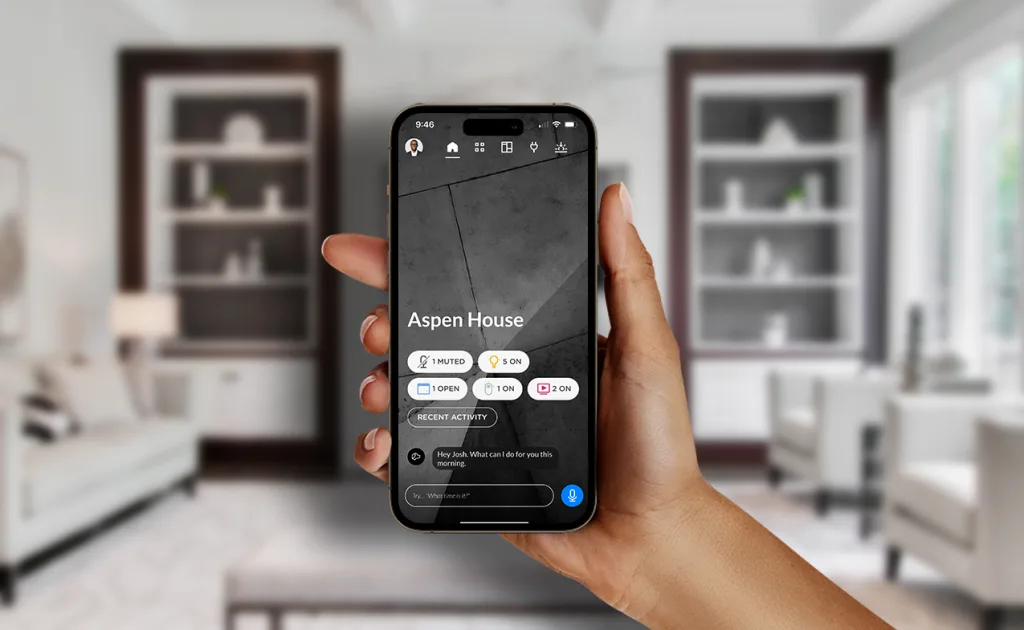
Here’s a fair question in 2026: why would anyone pay a few thousand dollars for a voice assistant when Alexa costs $30 and now actually holds a conversation? It’s a good question, and Josh.ai has a genuinely good answer. It just isn’t an answer most people need to hear. Josh is the luxury, privacy-first voice control system for high-end homes, and understanding who it’s for tells you a lot about where the mass-market assistants fall short.
What Josh.ai Actually Is
Josh.ai is a premium voice and touch control platform built for custom-installed smart homes. Instead of a plastic puck on your counter, it’s woven into the house itself, orchestrating lighting, climate, shades, security, and whole-home audio and video through natural conversation. You can string commands together the way you’d actually talk, “turn off the downstairs lights, lock up, and set it to 68,” and it just does it. It’s the kind of seamless, it-reads-your-mind experience the mass-market assistants keep promising and never quite deliver.
The Whole Point: Privacy and Hardware That Disappears
Two things justify the price, and the first is privacy. This is the anti-Alexa. Josh never sells your data or shares it for advertising, and you control how much your home collects in the first place. Its flagship device, the Josh Nano, processes commands locally, so your requests stay in your house instead of heading off to a server farm to be mined. In a category where the cheap option is fundamentally a storefront with a microphone, paying to not be the product is a real, coherent reason to buy.
The second is the hardware itself. The Josh Nano is billed as the world’s first “architectural microphone,” slightly larger than a quarter and designed to vanish flush into a ceiling or wall. For the kind of homeowner who spent real money making a space look a certain way and doesn’t want a row of black cylinders ruining it, gear that disappears is a genuine selling point, not a gimmick.
What It Costs, and Why You Can’t Just Buy One
Like the custom-install world it lives in, Josh.ai is quoted, not listed, and you can’t buy it off a shelf. In the US and Canada it’s distributed exclusively through Control4 dealers, so getting it means working with a professional integrator who designs and installs it as part of a larger system. Hardware for a smaller home starts in the low thousands and climbs quickly as you add the brains and microphones to cover a big property, and dealers typically layer on a plan for cloud features, updates, and support. If you’re already building a Control4 or other high-end system, Josh slots in as the voice layer. If you’re not, this isn’t your entry point.
Josh.ai vs Alexa: Who Each Is Really For
This is the honest heart of it. Alexa and Google are for the other 95% of us: cheap, everywhere, good enough, and improving fast with their new AI upgrades. Josh.ai is for the person building or renovating a higher-end home who wants three specific things the budget assistants can’t offer together, polished whole-home integration, genuine privacy, and hardware that’s invisible. That’s a real customer, just a narrow one. If your reaction to “a few thousand dollars for voice control” was a laugh, you are correctly not the target, and Alexa will serve you beautifully. If it was “finally, something that isn’t listening for Amazon,” you might be exactly who Josh built this for.
So, Is Josh.ai the Future?
Not the future for most homes, and that’s fine. It’s a glimpse of where premium voice control is going, private, ambient, and architecturally invisible, and the rest of the industry will slowly borrow those ideas the way the mainstream always borrows from the luxury end. For now, Josh.ai is the right call for one specific person: the custom-install homeowner who values privacy and design enough to pay for both. Everyone else should pocket the savings, grab an Echo, and check back in a few years when these ideas trickle down. If you’re weighing the systems all this would plug into, my smart home systems guide is the place to start.



