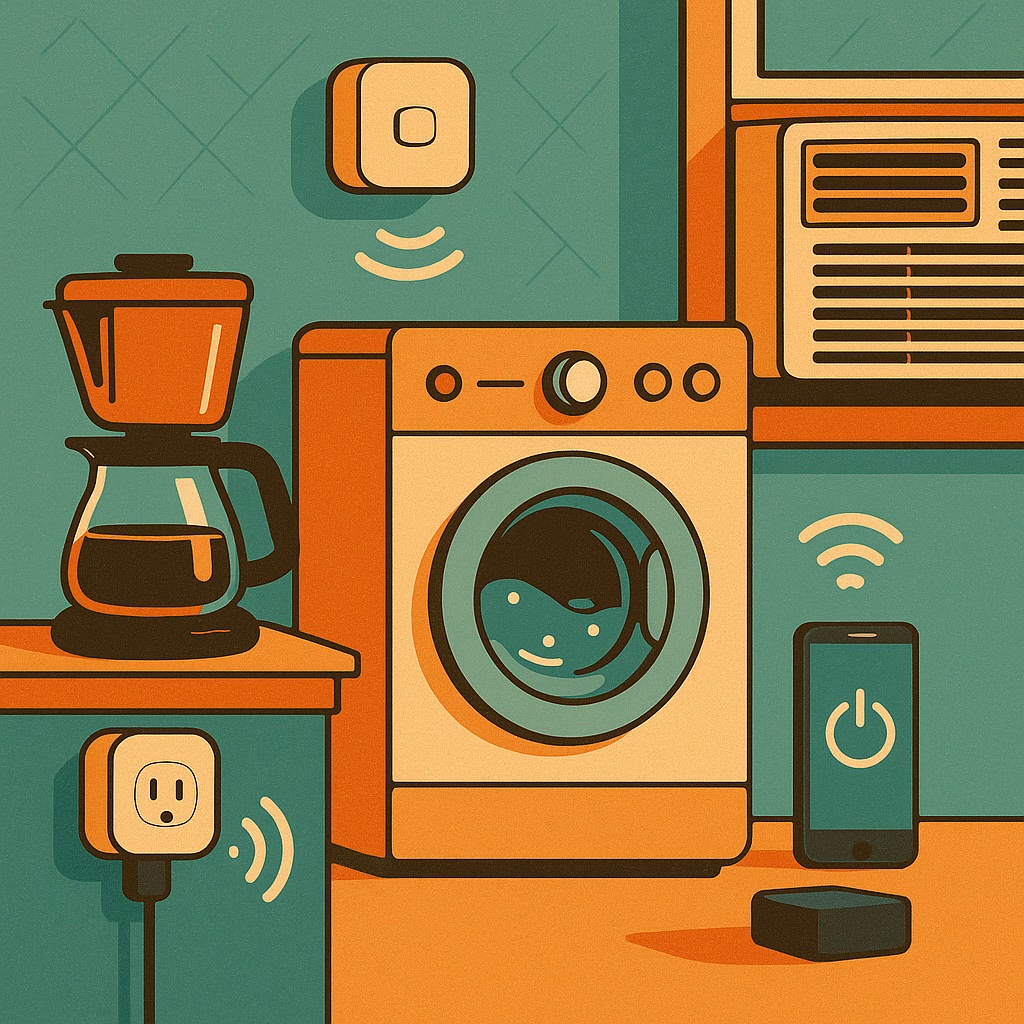
The bastards want you to throw everything away.
I was sitting in my home office in the western suburbs of Chicago, staring at another one of those slick smart home blogs, when it hit me like a freight train loaded with overpriced gadgets. These people – these smooth-talking tech evangelists with their venture capital smiles and affiliate link schemes – want me to replace my perfectly functional 2022 Oxo coffee maker with some $400 Wi-Fi enabled monstrosity that probably spies on my caffeine habits.
My coffee maker. The one that makes coffee. Every goddamn morning. Without fail.
But no, according to the gospel of Smart Home Jesus, this isn’t good enough anymore. Nothing is good enough unless it’s connected to the internet and sending data packets to some server farm in Silicon Valley. My ten-year-old washing machine that came with this old four-square house? Obsolete. Needs to go. The garage door opener that’s been faithfully lifting that heavy door for who knows how many years? Ancient technology, they say. Time for an upgrade.
The sheer audacity of it all. Here I am, dealing with a mortgage that feels like a python wrapped around my throat and two teenagers who think money materializes from thin air, and these people want me to throw thousands more at appliances that already work perfectly.
But there’s another way. A smart home retrofit path that doesn’t require selling your soul to the consumer electronics industrial complex.
The Great Smart Plug Revelation
It came to me during one of those long winter nights when the space heater in my office was humming away like a mechanical monk, converting electricity into warmth with the kind of honest simplicity that’s becoming extinct in this hyperconnected world.
Smart plugs. Not just for lamps anymore, my friends.
These little devices – these beautiful, subversive pieces of technology – can turn any appliance with a mechanical switch into part of your automated empire. Coffee makers, space heaters, fans, humidifiers. All of them susceptible to this twenty-dollar solution.
I’ve been running Aqara smart plugs for a while now, and they’ve proven themselves worthy soldiers in the war against planned obsolescence. One controls that space heater, automatically killing it when I leave for work so I don’t come home to find it’s been burning electricity all day like some kind of miniature power plant.
But here’s where it gets really interesting, where the rabbit hole opens up and swallows you whole. These Aqara plugs have energy monitoring built in. They can see into the electronic soul of your appliances, reading their power consumption patterns like tea leaves.
My washing machine, the ten-year-old beast that the smart home prophets want me to sacrifice, is plugged into one of these monitoring devices. I can watch the entire wash cycle unfold in real-time through power consumption graphs that look like EKG readouts from some electronic heart monitor.
Fill cycle: power spikes. Wash cycle: steady rhythm. Spin cycle: frantic energy. Completion: flat line.
When the power drops to near zero and stays there for five minutes, I get a notification. The cycle is complete. No more soggy clothes forgotten in the machine like casualties of a domestic campaign gone wrong.
This same surveillance technique works on dishwashers, dryers, any appliance with distinct operational phases. It’s like having x-ray vision into the mechanical workings of your domestic infrastructure.
The IR Blaster Epiphany
Summer in Illinois is a special kind of hell, and our attic window AC unit was the enemy. Old, cantankerous, requiring precise remote control aim like some kind of climate control sniper rifle. Half the time it ignored commands entirely, as if it had developed its own mechanical attitude problem.
The Broadlink IR blaster changed everything. This device learns infrared signals from any remote and replays them on command, turning your dumb appliances into obedient servants of the digital age.
Now the AC unit responds to schedules I program from my phone. It kicks on an hour before bedtime, creating a cool sanctuary upstairs, then shuts off automatically to prevent those 3 AM ice-age wake-ups that used to plague our summers.
The setup process felt like teaching a robot to speak the ancient language of infrared. Point the blaster at the AC, press buttons on the original remote to transfer knowledge, then watch as your phone becomes the command center for climate control.
Range is impressive. One strategically placed IR blaster can control multiple devices across a room, spreading its influence like some benevolent electronic overlord.
The SwitchBot Solution for Mechanical Rebellion
Sometimes you need a robot finger to press buttons. I know that sounds like something from a fever dream about the future of domestic automation, but SwitchBot Bot makes it a reality.
For appliances that resist simple power control, that require specific button presses to initiate their cycles, this little mechanical soldier can bridge the gap between analog controls and digital automation.
Haven’t pulled the trigger on one yet, but I keep circling back to it like a moth drawn to out front porch lighting. There are situations around this old house where a robotic button-pusher might be exactly what’s needed to bend stubborn appliances to my automated will.
Garage Door Conquest Without Financial Massacre
The garage door opener industrial complex wants you to believe that smart automation requires replacing your entire system. Spend a thousand dollars, they whisper. Rip out the old, install the new, embrace the future.
Lies. All lies.
The MyQ garage controller retrofits existing openers for a fraction of that cost, working with nearly any system built after 1993. Installation requires basic electrical skills — connecting wires, mounting sensors — the kind of work that comes naturally after years of maintaining an old house that demands constant attention.
Now I can verify garage door status from anywhere, ending those middle-of-the-night anxiety spirals about whether I remembered to close it. With two teenagers in the house, this automation prevents potential security lapses that could turn into bigger problems.
The peace of mind alone justifies the modest investment. No more driving back home to check. No more lying awake wondering. The app shows current status with digital certainty.
Motion Sensor Guerrilla Tactics
Sometimes the most effective way to make dumb devices smart is through indirect action. Instead of retrofitting the appliance itself, you automate the environment around it.
Our guest bathroom became a testing ground for this philosophy. Rather than attempting to modify the exhaust fan directly, I installed a motion sensor that controls it through a smart switch. Enter the room, fan activates. Leave the space, timer runs for fifteen minutes, then silence returns.
Guests never need to locate the switch. The fan operates consistently, managing humidity in this old house that seems to collect moisture like a sponge. Energy waste disappears through automatic shutoff.
This indirect approach extends throughout the house. Motion sensors paired with smart plugs can activate space heaters upon room entry, trigger humidifiers based on occupancy, create responsive environments that react to human presence without requiring appliance modification.
The Energy Monitoring Awakening
Real-time power consumption data changes everything. Once you can see the electronic heartbeat of your appliances, patterns emerge that were previously invisible.
Is the basement mini-fridge consuming more electricity than expected? Is your water heater cycling with suspicious frequency. These insights surface through energy monitoring that reveals the hidden consumption patterns of domestic machinery.
The washing machine power signature tells a complete story. Each phase of operation creates distinct electrical fingerprints that, once learned, provide perfect timing information for automation triggers.
No more guessing when cycles complete. No more checking and rechecking. The power consumption patterns provide definitive answers about appliance status with scientific precision.
Safety in the Age of Automated Rebellion
Common sense still applies in this brave new world of retrofitted automation. Don’t exceed power ratings. Don’t leave high-wattage devices unattended on timers. Don’t assume smart plugs possess magical protective powers beyond their specifications.
Quality devices include overload protection, but physics still governs electrical reality. A 1500-watt space heater needs a smart plug rated for at least that capacity. Ignore these ratings at your own peril… and that of your home’s electrical system.
Most retrofit approaches avoid warranty voidance since they don’t modify appliances directly. External control and power management typically fall outside warranty restrictions, but verify terms for specific devices if coverage concerns exist.
The Gradual Revolution Strategy
Don’t attempt to automate everything simultaneously. Pick one appliance that genuinely irritates you, like that space heater forgotten for hours, that garage door status mystery, that laundry cycle guessing game.
Start there. Learn the automation patterns that actually improve daily life versus those that merely sound technologically impressive. Build knowledge through experimentation rather than speculation.
Incremental investment reduces financial risk while teaching valuable lessons about practical automation. What works in theory doesn’t always translate to useful reality. Small-scale testing reveals these truths without major commitment.
Integration Into the Larger Campaign
Individual device control represents just the beginning. Real value emerges when multiple retrofit solutions combine into coordinated routines that genuinely enhance daily flows.
“Leaving for work” automation sequences can simultaneously shut off space heaters, verify garage door closure, and adjust climate control settings through various retrofit technologies working in concert.
Most solutions integrate with major voice assistant platforms, enabling control despite using different brands and approaches. The ecosystem becomes greater than the sum of its individual components.
Try these to start:


The Economic Reality Check
Smart appliance markup represents pure profit extraction from consumers who’ve been convinced that connectivity justifies massive price premiums. Smart coffee makers cost double what regular ones plus smart plugs would cost. Smart garage door openers demand significantly more than retrofit alternatives.
Retrofitting typically costs 30-50% less than purchasing smart replacements for everything. When appliances eventually require replacement, retrofit devices transfer to new equipment, preserving automation investments.
Environmental consciousness also factors into the equation. Functional appliances destined for landfills to accommodate “smart” upgrades represents waste on a massive scale. Retrofitting extends useful life while adding desired functionality.
The Rental Property Advantage
This retrofit philosophy works perfectly for rental situations where permanent modifications are prohibited. Everything remains portable and removable, traveling with you through housing transitions.
External automation doesn’t require landlord approval or property modification. Smart plugs, IR blasters, and retrofit controllers operate independently of building infrastructure while providing genuine smart home benefits.
Final Assessment
My Oxo coffee maker makes excellent coffee. The ten-year-old washing machine handles laundry with mechanical reliability. The garage door opener performs its singular function without complaint.
These appliances don’t require replacement to participate in smart home automation. They need strategic retrofit solutions that add connectivity and control without sacrificing proven functionality.
The smart home retrofit approach represents resistance against planned obsolescence and consumer manipulation. It’s practical problem-solving rather than marketing-driven consumption.
Start with one genuinely problematic appliance. Test retrofit solutions before considering expensive replacements. You might discover that simple external automation solves problems more effectively than throwing money at entirely new equipment.
The revolution doesn’t require destroying everything that works. Sometimes the most radical act is making the old work better than the new ever could.
Frequently Asked Questions:
A: It depends on what you’ve got. If your appliance has a simple mechanical switch that stays “on” when you flip it, smart plugs will work great. Coffee makers, space heaters, fans – most of these are perfect candidates. If your device has electronic controls that require button sequences, you might need something like SwitchBot or an IR blaster. The good news is most of these solutions cost under $50, so you’re not risking much to find out.
A: Most of it is pretty straightforward. Smart plugs literally just plug into the wall – no installation required. IR blasters are basically point-and-click setup through an app. The garage door retrofit (MyQ) requires some basic wiring, but if you’re comfortable changing a light fixture, you can probably handle it. If not, an electrician can install it in about an hour. Start with the easy stuff first and work your way up.
A: Probably not, since you’re not actually modifying the appliances themselves. You’re just controlling their power supply or using external automation. But honestly, read your warranty paperwork if you’re concerned. Most of these retrofits are completely external – smart plugs, IR blasters, motion sensors – so they shouldn’t affect coverage. I’ve never had an issue, but every manufacturer is different.
A: In my experience, retrofitting costs about half what buying smart versions would cost. A smart coffee maker might run $200-300 versus a $25 smart plug on your existing one. Smart garage door openers can cost $800+ while MyQ retrofit kits are under $100. Plus when your appliances eventually break, you can move the smart controls to whatever you buy next. The automation investment doesn’t disappear.
A: Pick something that genuinely annoys you in your daily routine. For me it was that space heater I’d always forget to turn off. A smart plug solved that problem for twenty bucks. Coffee makers are also great starter projects if you want scheduling. Or try the garage door if you’re one of those people who lies in bed wondering if you closed it. Start with your biggest daily frustration and go from there.



