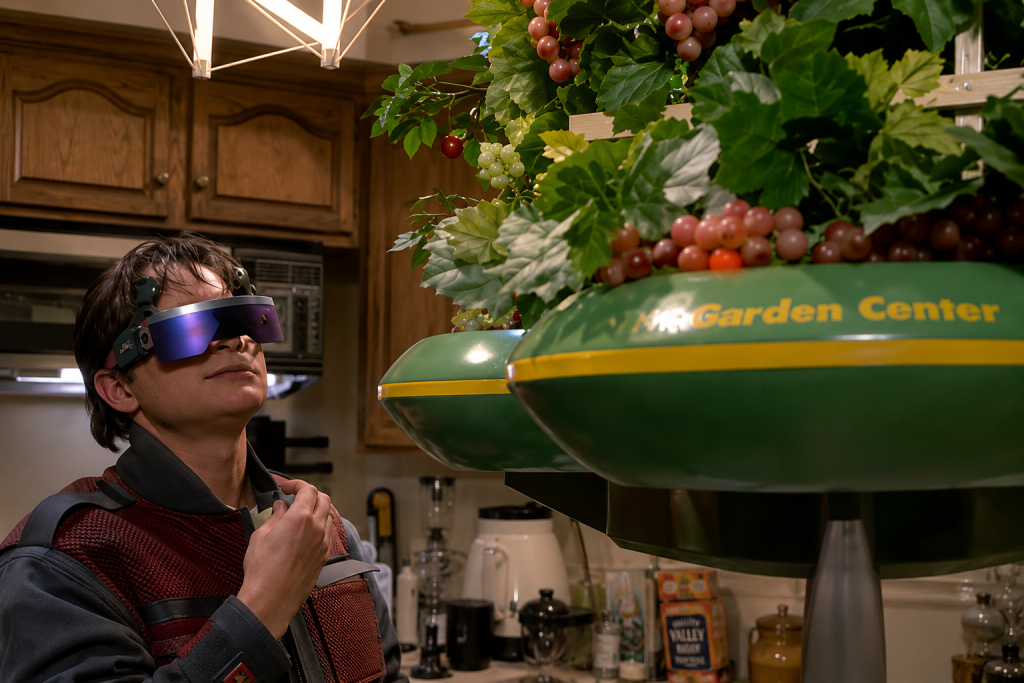
When I was a kid, the future had a thermostat you never touched and a house that knew your name. I watched Back to the Future Part II until the tape wore thin, and I loved every frame of it. The hoverboard. The flying DeLorean. I loved that car so much that years later I sat in the real one, the actual movie DeLorean, and there is a picture of a grown man grinning like it is 1989. I regret nothing. But the part that quietly rewired my brain was the McFly house. You walk in, the lights come up, a screen on the wall says who is calling, and a Pizza Hut the size of a drink coaster goes into the hydrator and comes out two seconds later feeding the whole family. I was certain that one was coming. I am still a little bitter it has not. Fresh fruit hung in a basket that dropped out of the ceiling when you called for it. The whole place just seemed to be paying attention to you. The Jetsons sold me the same dream a decade earlier, push a button and the house handles it, Rosie rolls in to do the parts the buttons missed.
And that is the part I did not fully appreciate as a kid. The technology was everywhere in their lives and invisible at the same time. The cars, the hoverboards, the self-drying jacket, the house, even how they made dinner. Nobody in that family ever stopped to admire any of it, because it all just worked. That was the promise. A home that takes care of the people in it so they can get on with the business of living. Not a house you operate. A house that operates itself, quietly, in the background, while you do literally anything else.
Then 2015 actually arrived, the real one, and the shoes did not lace themselves. We got a different future instead: seventeen apps, four ecosystems that refuse to speak to each other, and a video doorbell that wants a firmware update before it will admit there is a person standing on the porch. The dream did not die. It just got outsourced to a committee that forgot what the dream was for.
I have spent a few years now writing about this stuff, testing it in my own house, and getting genuinely irritated at how often “smart” makes things harder. So I want to do something I do not usually let myself do here. I want to be optimistic. Because in 2026, for the first time, the future I was promised is actually starting to show up. Not with a parade. More like it snuck in the back door while everyone was arguing about which voice assistant is least bad.
What We Were Promised (and Who Kept Selling It Back to Us)
Here is the thing about the smart home dream. Nobody ever stopped selling it. Every January, like clockwork, a company wheels a robot onto the CES stage and tells us this is the year the house comes alive. The lights dim on cue. An executive asks the robot to do something charming. The crowd claps. And then most of those robots are never heard from again.

The patron saint of this routine is Samsung’s Ballie, a little rolling robot ball that has been touring the CES circuit for something like half a decade. It was going to project movies on your wall, follow you around, run your home. It got a bigger body and more AI for its 2024 encore. It was promised for the summer of 2025. That came and went. It skipped CES 2026 entirely, and the signup page quietly disappeared, which is the tech equivalent of a band canceling the tour and not telling anyone. Word is it would have run north of two grand anyway. Amazon’s Astro is in the same neighborhood, technically real, still invite-only, sixteen hundred dollars, and mostly a very expensive way to have a screen drive itself into a doorframe.
I am not dunking on the engineers. Building a robot that lives in a messy house full of stairs and dogs and kids leaving backpacks in the hallway is genuinely hard. I am dunking on the pitch. For twenty years the industry sold us the butler and delivered a brochure. The gap between the promise and the thing in the box is the whole reason this site exists.
What We Actually Got (a Brief and Honest Accounting)
Let me be fair to the present before I get excited about the future. A lot of what we got is good. My Lutron Caseta lights come on at dusk and shut off at dawn, and they have quietly adjusted themselves as the seasons shift for years now. I never think about them, which is the highest compliment I can pay a piece of technology. That is the dream working exactly as advertised. I have watering that handles itself and a few other corners of the house that genuinely recede into the background the way they are supposed to.

But for every one of those, there is a Siri. Siri is the living monument to the gap between what we were promised and what we got. It was supposed to be the friendly intelligence at the center of the Apple house, the thing you just talk to. Instead it has spent years not quite understanding “set a timer for nine minutes,” and the long-promised smart version keeps slipping. We will come back to Siri, because it is about to become the most expensive punchline in the industry.
Credit where the movie earned it, though. The one scene from that 2015 that arrived almost frame for frame is the worst one. Future Marty gets goaded into a bad decision by Needles on a wall-screen video call, the boss barges into the feed, and the firing lands in real time. That is just a Tuesday on Teams now. The detail they missed is the punchline. The “YOU’RE FIRED” arrives by fax, in triplicate, printing all over the house. They saw the video call coming decades out and still could not imagine losing the fax machine. Which might be the most honest lesson in the whole movie. Even when you get the future right, you get the plumbing wrong.
The deeper problem was never any single gadget. It was that none of them talked to each other. You bought a smart bulb and a smart lock and a smart plug, and each one demanded its own app, its own account, its own little fiefdom. The “system” was you, standing in the kitchen, being the integration layer between four companies that would rather you only bought from them. That is not a connected home. That is a part-time job you pay for.
The Quiet Part That Is Finally Going Right
So here is the optimism, earned and specific. The pieces that actually make the dream work are landing right now, and almost none of them look like a robot.
The big one is boring and I love it for being boring. It is called Matter, and it is basically a USB-C moment for the home. The idea is dead simple. One common language so your lock, your lights, and your thermostat all just work together regardless of who made them or which app you prefer. For years it was more press release than product. In 2026 it is finally getting real, with more of the holdouts quietly falling in line and adding support. It is not glamorous. Nobody is going to make a movie about a protocol. But interoperability is the thing the Jetsons took for granted and we never had, and it is the foundation everything else sits on. The plumbing is finally getting installed.
On top of that plumbing, the AI conversation is shifting in a way that actually matters. For a couple of years “AI in the smart home” meant a chatbot bolted onto a speaker so you could talk to it in slightly fancier sentences. The interesting move at CES this year was the industry talking less about AI features and more about AI coordination. The pitch is a home that stops waiting for commands and starts anticipating, noticing that you always drop the temperature and dim the lights at ten, and just doing it, then getting out of the way. That is the actual dream. Not a robot that fetches your slippers. A house that learns your rhythm and quietly runs to it. We are not all the way there. But for the first time the industry is aiming at the right target.
I got a small taste of what that feels like, and it was almost annoying how good it was. For a stretch this spring my mornings basically ran themselves. The lights came up slow before the alarm, the thermostat nudged the house warm, the kitchen speaker read me the day while I made coffee. None of it asked. The catch is that it worked because I had spent a Saturday wiring the whole routine by hand, the old way, like a guy hunched over a VCR trying to stop it blinking 12:00. The promise of the coordinated home is that you get to skip the Saturday. The house watches for a few days, figures out that this is just what I do at six in the morning, and offers to run it for me. We are right on the edge of that being normal instead of a weekend project.
Then there are the small, almost invisible wins that feel the most like the movies. There are new locks using ultra-wideband that unlock as you walk up to the door, no phone fumble, no keypad, the house simply recognizing it is you and letting you in. That is the McFly front door, and it is shipping. Meanwhile IKEA, of all companies, is selling sensors for a few bucks, which matters more than it sounds. The future does not arrive when the two-thousand-dollar robot ships. It arrives when the five-dollar sensor does, because that is when normal people can actually build the thing.
The Screen on the Wall, and the Voice That Will Not Cooperate
Now for the device that is the promise and the punchline at the same time. Apple has been building a little smart home hub, a roughly seven-inch square screen you stick on the wall, with a camera that knows your face and a price somewhere around three hundred and fifty bucks. On paper it is the McFly wall panel, the thing that says who is at the door and runs the house. It is reportedly been finished and sitting on a shelf for months.
And it cannot ship. Because it runs on the new Siri, and the new Siri is not ready, again. The launch has slid from early 2025 to early 2026 to, now, sometime around the fall, riding on a software update Apple keeps not finishing. So the most polished hardware version of the dream we have is being held hostage by the exact assistant that has symbolized the broken promise for a decade. You could not write it better. The hardware is the future. The voice inside it is still the past, insisting it cannot find that on the web.
The voice race itself is genuinely improving, which is the good news. Amazon’s Alexa+ got a real generative-AI brain and is, by most accounts, reliable at the unglamorous job of actually executing commands across a mixed-up house. Google’s Gemini for Home is sharper at understanding the messy, multi-step stuff you actually say out loud, the “turn off everything downstairs except the kitchen and remind me to move the laundry in forty minutes.” They each do half the job well. Nobody has shipped the one assistant that nails both. But the half-jobs are getting good enough that you can feel the full one coming.
The Robot Is Coming, Sort Of, and It Is a Screen With a Neck
I would be lying if I said the Rosie fantasy was dead. Apple is reportedly working on a tabletop gadget that is essentially an iPad on a little motorized arm, so the screen physically turns to face you as you move around the room. A simpler version may show up first, with the arm-waving model a year or so behind. It is not going to fold your laundry. It is a face on a neck that follows you around the kitchen.
And honestly? That might be the most realistic version of the dream, because it is the one that admits what the home robot is actually for. We do not need a metal maid. We tried the maid pitch for twenty years and got a ball that rolls into walls. What we need is for the house to be present, to turn toward us, to keep the useful thing in view while we cook or work or wrangle the kids. A screen with a neck is a humbler dream than Rosie. It is also one that might actually arrive and stay.
The Catch, Because There Is Always a Catch
I am not going to pretend the brochure is finally true. A few things still need saying plainly.
The first is the subscription trap, which is the new way the dream gets clawed back. The hardware keeps getting cheaper and better, and then the genuinely useful AI feature shows up wearing a monthly fee. Some of it comes bundled, for now. But “for now” is doing heavy lifting, and the smart-home graveyard is full of features that were free until they were a line item. Watch your wallet as closely as your front door.
The second is the camera in the room, literally. The slickest version of “the house knows it is you” runs on a lens that reads your face and a microphone that is always half-awake, listening for its name. That is the trade the McFly house never mentioned. I am not in the tinfoil camp, I run plenty of this gear myself, but a home that watches and listens in order to help is still a home that watches and listens, and where that data ends up is a fair question to ask out loud before you bolt the thing to the wall. And I will say the quiet part. Even with a house full of this gear, it still creeps me out a little. It probably should. The honest fix is local, keep the thinking inside the house, on the device, so your living room never leaves the building. A few of the better systems are finally starting to work that way, and it is the right direction. But mostly we are not there yet, and until we are, a little unease is not paranoia. It is the correct reading of the fine print. The dream is a house that pays attention to you, not one that files reports on you. Worth keeping those two straight.
The third is that the throwaway machine is still humming along underneath all of it. The industry would love for you to replace the whole house every three years, to treat a perfectly good hub as e-waste because the new one has a slightly faster chip. The reason Matter matters, and the reason set-and-forget gear like my old Lutron lights is the gold standard, is that the real dream is stuff that lasts and keeps working, not stuff you re-buy on a schedule. Seamless does not mean disposable.
And the last one is the simplest. A lot of this is still rumor and slipped ship dates. Ballie taught us to hold the applause until the box is on the porch. I am optimistic, not naive.

Where We’re Actually Going
Here is what I believe, sitting in a house old enough to have its own opinions about wiring, watching lights I set up years ago come on without me. The future of the smart home was never the flying car. It was the part of Back to the Future nobody put on the poster: the house that pays attention so you do not have to.
We are closer to that than we have ever been, and the proof is not the robot on the CES stage. It is the boring protocol that lets your stuff talk. It is the lock that knows your walk. It is the five-dollar sensor and the assistant that finally understands a normal sentence and the screen that turns to face you. None of it is a parade. All of it is the dream arriving the way real things arrive, quietly, unevenly, a piece at a time, while the marketing keeps promising the parade.
What I want out of all this is small and has not changed since I was a kid in front of that TV. I want a house that takes care of the people in it. I want the lights to handle themselves and the door to know my daughters and the whole thing to fade so far into the background that nobody in my family ever has to think about it. That is the future worth chasing. Not a home that demands your attention. A home that quietly gives it back.
If you want to start building your own version of it without waiting on Apple to finish Siri, the smart home from scratch guide is where I would begin, and the garden that waters itself is proof the recede-into-the-background dream already works in at least one corner of the yard. The future is not all the way here. But for the first time in a long time, I can see it from the porch.



