Last updated July 13, 2026. This page gets refreshed quarterly.
Every smart home statistics page on the internet quotes every other smart home statistics page. Chase a number back three links and you usually land on a blog quoting a blog quoting a misread chart. I got tired of it, so this page works differently. Every figure below comes from the actual study, with the actual source linked, and the year it refers to. Where a number is a vendor’s “up to” claim or a stat I could only verify secondhand, it says so.
If you’re writing about smart homes, cite anything here freely. A link back is appreciated. The sources are linked so you can check my work, which is more than most of these pages will offer you.
Adoption. It’s officially mainstream
- About 45% of US internet households own at least one core smart home device, and that count excludes smart speakers, so it’s the strict measure. (Parks Associates, 2025)
- ~13 million US households entered the smart home market since 2020, bringing the base to roughly 54 million households. (Parks Associates, 2025)
- The stat I find most telling. 38% of smart home buyers now identify as “Early Majority,” up from 20% six years ago. The tinkerers stopped being the market. Normal people are buying this stuff, which is exactly who gets overwhelmed by it. (Parks Associates, 2025)
- The average US internet household ran 17 connected devices as of Q3 2023. (Parks Associates, announced at CES 2024)
- Deloitte counts it at 21 connected devices per household, down from the pandemic peak of 25 in 2021. People are consolidating, not accumulating. (Deloitte Connected Consumer Survey, 2023)
- Worldwide, smart home penetration was 16% of households in 2023. Keep this one handy for the debunk section below. (Statista Market Insights)
Market size. Big, and the forecasts do not agree
Most stats pages present one market-size number like it’s settled fact. Here are three current forecasts side by side, so you can see the spread for yourself. Same yard, very different fences.
- Statista Market Insights (accessed July 2026) puts global smart home revenue at $159.5 billion in 2026, heading to $184.6 billion by 2031, with the US as the largest single market at $20.1 billion.
- MarketsandMarkets uses a broader definition and gets $213.7 billion in 2025, projected to $450.2 billion by 2032 (11.8% CAGR).
- Fortune Business Insights runs hotter still. $147.5 billion in 2025, projected to $633.2 billion by 2032 (23.1% CAGR).
The honest takeaway is that “the smart home market” is worth somewhere between $150 and $215 billion right now depending on what you count, and everyone agrees it’s growing. Treat any single forecast as directional, not gospel.
- North America alone. $32.6B in 2025, projected to $45.7B by 2030. (MarketsandMarkets)
- Device shipments crossed 1.06 billion units in 2025, on the way to 1.5 billion by 2030. (ABI Research)
Energy. The honest savings numbers
This is the section where vendors round up and bloggers round further. The defensible numbers:
If you would rather measure your own numbers than trust a chart, that is exactly what the best energy-monitoring smart plugs are for.
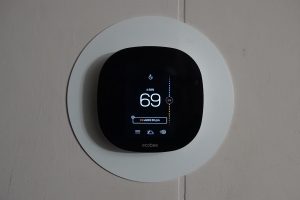
- ENERGY STAR certified smart thermostats save about 8% of heating and cooling bills, roughly $50 a year on average. Field data, not lab promises. That’s the number I’d plan a budget around. (EPA ENERGY STAR)
- To even earn the ENERGY STAR label, a thermostat has to demonstrate at least 8% heating and 10% cooling runtime reduction in real homes. (EPA)
- The famous Nest studies found 10-12% heating and 15% cooling savings. Still the most-cited numbers in the category. They’re from 2015, so date them if you use them. (Nest white paper, 2015)
- ecobee claims customers save up to 26% on heating and cooling costs. Vendor math with an “up to” in front of it, from an internal 2021 analysis. Treat accordingly. (ecobee)
- US utilities had ~119 million smart meters installed as of 2022, roughly 72% of all electric meters. (EIA) Residential penetration passed 70% for the first time in 2024. (FERC 2024 assessment)
Run your own numbers against our energy savings calculator before you buy anything.
Security and cameras
- 30% of US internet households own a smart camera or video doorbell. (Parks Associates, 2024)
- 43% of US internet households own a security solution, and almost a third subscribe to a monitoring service. (Parks Associates, 2024)
- 20% of households own a video doorbell specifically. (Parks Associates, 2025)
- The classic deterrence stat, from actual convicted burglars. ~60% said they’d seek a different target if an alarm was present. It’s from 2013 and it’s still the definitive study, because nobody else has interviewed 422 incarcerated burglars since. (UNC Charlotte)
Voice assistants. Plateaued, then AI showed up
- eMarketer’s 2025 forecast has US voice assistant users growing from 139.8 million in 2022 to 168.2 million by 2029, roughly 3% a year. The mid-decade figure most pages quote is about 154 million for 2025. (eMarketer, 2025)
- The US platform split circulates as Google Assistant 92.4M, Siri 87M, Alexa 77.6M, with heavy overlap between them. Full disclosure, eMarketer’s report is paywalled and these brand numbers only circulate secondhand, so treat them as approximate. Alexa still owns the smart speaker itself.
- 35% of Americans 12+ own a smart speaker, and that number has been stuck at roughly a third of the country for four straight years (33, 35, 36, 34, 35 from 2021 to 2025). The hardware race is over. The intelligence race just started. (Edison Research Infinite Dial, 2025)
- Alexa+ launched in early 2025 at $19.99/month, free for Prime members (Amazon), and went broadly available in the US in February 2026 (Amazon). Your speaker now has a subscription tier.
Matter and Thread. Slowly, then all at once
Context for all of these lives in our Matter compatibility guide.
- Matter 1.5 (November 2025) finally added cameras, plus soil sensors and “closures,” the spec’s word for blinds, shades, gates, and garage doors. (Connectivity Standards Alliance)
- 750+ distinct Matter products are shipping or launching as of January 2026, per the independent matter-smarthome.de tracker, which strips out color variants and regional duplicates instead of inflating the count. (matter-smarthome.de)
- Since January 1, 2026, new Thread border routers must certify on Thread 1.4, which addresses the parallel-networks mess that made Thread flaky in mixed-brand homes. Thread Group hasn’t published the deadline on its own site, so this one traces to Thread Group statements reported by matter-smarthome.de and The Verge. Secondhand, flagged accordingly.
- Home Assistant became the first open-source project to earn Matter certification in March 2025. (Home Assistant)
What consumers actually think

- 52% of DIY smart home users hit setup or connectivity problems. Half. This is why troubleshooting guides exist and why “it just works” remains the industry’s biggest unkept promise. (Parks Associates, 2025)
- 70% of US consumers worry about the privacy and security of their data. (Deloitte, 2025)
- Only 48% say the benefits of connected devices outweigh their privacy concerns, a steep drop from 58% just a year earlier. (Deloitte, 2025)
- Only 27% have high trust that the companies making these devices keep their data secure. (Deloitte, 2025)
- Cost is the top barrier, cited by 46% of adopters and 52% of non-adopters. (ASHB / Harbor Research, 2025)
- Safety and security is the top purchase driver at 55.9%, and 43.5% have privacy concerns specifically about AI features. (ASHB / Harbor Research, 2025)
Stats you should stop citing
The debunk section. These circulate everywhere and they’re wrong, or they’re unkillable zombies.
- “Global smart home penetration will hit 82% in 2026.” No. That’s a misreading of a Statista chart that content farms keep recycling from each other. Statista’s actual figure was 16% global household penetration in 2023. If a stats page quotes 82%, close the tab.
- “Smart thermostats save 23%/26%/30% on energy bills.” Those are vendor “up to” claims promoted to averages. The field-tested average is about 8% of heating and cooling costs, per the EPA.
- Any stat with no year attached. The market changes fast enough that an undated number is a wrong number.
Cite this page
Everything above is free to use. Cite it as “Home Sync’d, Smart Home Statistics 2026” with a link to this page. If a number here is wrong or goes stale, email me at chris@homesyncd.co and I’ll fix it, which is also more than most of these pages will offer you.